

How to Choose Curtains for a Living Room in Dubai: The Ultimate Guide
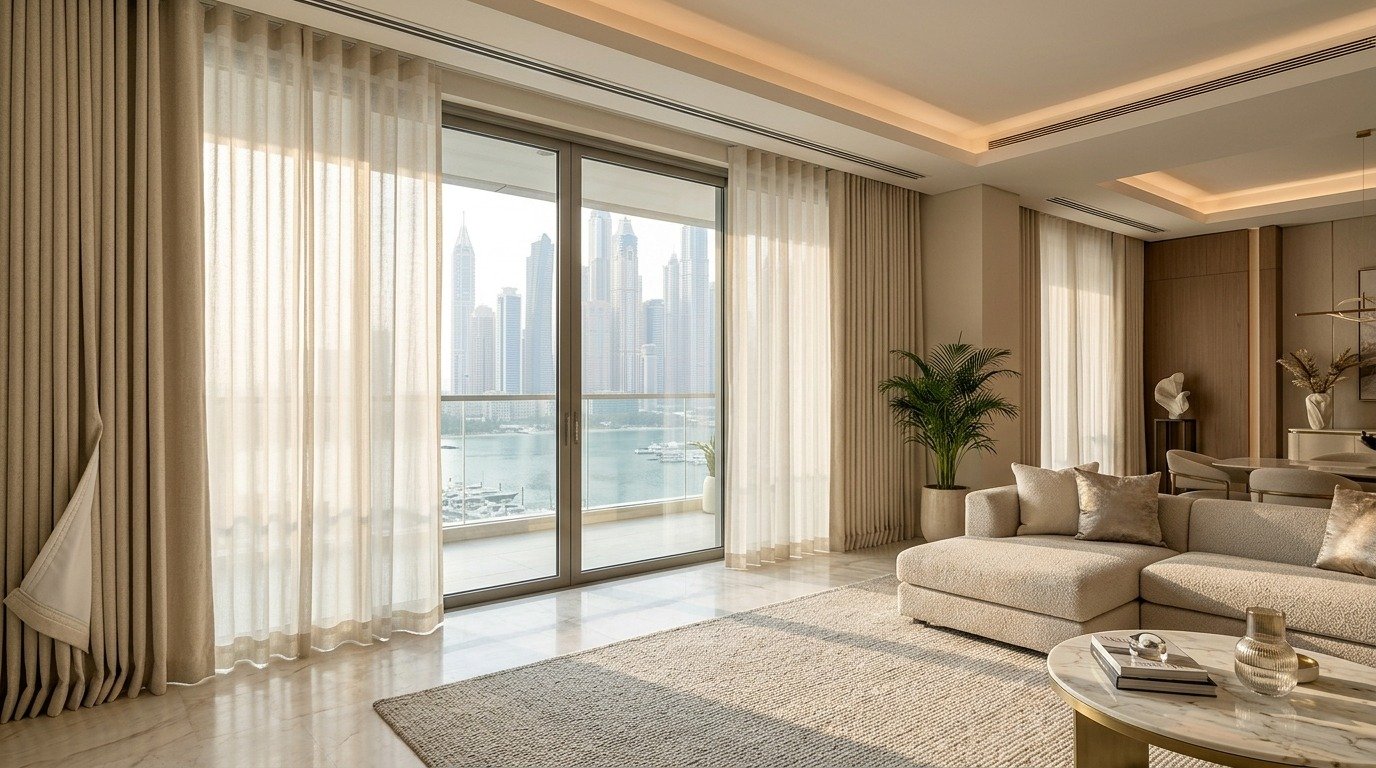
The best curtains for your Dubai living room balance three things: UV and heat protection for the intense desert climate, a style that fits your home decor, and proper sizing for your windows. Most Dubai homeowners choose a combination of blackout curtains for daytime heat control and sheer layers for evening ambiance, installed floor-to-ceiling for maximum impact. In our experience at Curtain Crew, the right choice depends on your window size, room heat exposure, and whether you prefer motorized convenience or traditional manual operation. Choosing the perfect living room curtains in Dubai isn’t just about picking a pretty fabric—it’s about protecting your furniture, controlling temperature, and creating the exact mood you want.
Why Living Room Curtains Matter More in Dubai Than Anywhere Else
Dubai’s desert heat and intense sunlight create challenges that most homeowners outside the UAE never face. Therefore, your living room curtains serve two critical jobs: protecting your home and looking beautiful while doing it.
First, the sun here is relentless. In summer, temperatures regularly exceed 45°C, and direct sunlight through large windows can fade your furniture, artwork, and flooring in just months. Moreover, that same sunlight raises your indoor temperature significantly, forcing your air conditioning to work harder and driving up energy bills. On the other hand, quality curtains with thermal backing can reduce indoor temperatures by up to 10°C and lower AC costs by 15-25%, which adds up quickly in a region where cooling runs year-round. Second, privacy matters in high-rise living. If you’re in a Dubai Marina apartment or a Downtown tower, neighbors’ buildings are close by. In addition, during the long sunny days, daytime privacy is important even when you want natural light. Furthermore, evening privacy becomes essential for nighttime comfort.
What Is the Best Fabric for Living Room Curtains in Dubai?
The fabric you choose makes or breaks your curtain investment. In fact, choosing the wrong material in Dubai’s climate can mean fading, tearing, or loss of shape within a year. Here are the top options we recommend for Dubai living rooms:
Blackout Polyester – The Practical Choice
Polyester is the hardworking fabric of the curtain world. Specifically, quality polyester curtain fabric
withstands Dubai’s heat and dust without fading or breaking down. Because polyester dries quickly, it resists mildew—a real concern in humid coastal areas like Dubai Marina and JBR. Additionally, it’s affordable and easy to clean. On the downside, some people find polyester less luxurious than natural fibers, and cheaper polyester can feel stiff.
For a visual look at how polyester performs against other fabrics, check out our detailed polyester curtain fabric guide to see exact durability comparisons and price tiers.
Linen Blends – Style Plus Durability
If you want curtains that look sophisticated and still perform in Dubai’s heat, linen blends are worth the investment. Specifically, a 70-30 or 60-40 linen-cotton blend offers the soft drape of natural fabric with the durability of synthetics. However, pure linen is delicate in direct sun and needs careful maintenance. Therefore, most of our clients in Arabian Ranches and Downtown Dubai prefer the blend. Furthermore, linen blends have a timeless, premium appearance that complements modern and traditional interiors alike.
Velvet – The Luxury Option
Velvet is the showstopper. When you see floor-to-ceiling custom velvet drapes in Dubai homes, you understand the impact—deep colors, soft texture, and incredible light-blocking ability. Velvet naturally blocks 95-100% of light and heat, making it ideal for large, sun-exposed windows. On the other hand, velvet is pricey, requires professional cleaning, and can trap dust in its pile, which matters in the UAE’s dusty climate. In short, velvet suits living rooms where style is the priority, and you’re willing to invest in maintenance.
How Do I Choose Between Blackout and Sheer Curtains for Dubai Living Rooms?
This is the question we hear most often. Here’s the straightforward answer: most Dubai homeowners use both. Therefore, we’ll explain each and show you why a layered approach works best.
Blackout Curtains
Blackout curtains block 99% of light and UV rays. Specifically, they have a light-blocking coating or dense weave that stops heat and prevents fading. Because of this, they’re essential during Dubai’s 13-hour summer daylight. Moreover, blackout curtains reduce glare on screens during the day. In addition, they provide complete privacy day and night. For more details on the benefits of blackout options, see our blackout curtains buying guide covering opacity levels, benefits, and installation tips for high-rise apartments and villas.
Sheer Curtains
Sheer curtains filter light softly, reduce glare, and add a breezy, open feel to a room. However, they offer little heat or UV protection and provide minimal privacy. Therefore, sheers work best as a daytime-only layer or in combination with blackouts.
The Best Strategy: Double-Layer Curtains
Many Dubai homeowners and interior designers combine both for maximum flexibility. Specifically, install blackout curtains on the inside and sheer curtains on the outside (or vice versa). In the morning, open the sheers to let soft light in while keeping heat and UV rays out. In the afternoon, close the blackouts for complete temperature control. At night, both layers provide privacy and insulation. As a result, you get style, comfort, and energy savings all at once.
How to Measure Living Room Windows for Custom Curtains in UAE
Getting the measurements wrong is the most common and costly mistake we see. Therefore, take your time with this step. Here’s exactly how we measure at Curtain Crew:
Step 1: Measure the Height
Measure from the top of your window frame (or ceiling for floor-to-ceiling curtains) to the floor. Specifically, take three measurements: left, center, and right of the window. Because windows and floors are often uneven, use the longest measurement. In addition, decide whether you want curtains to kiss the floor (1-2 inches clearance) or puddle slightly (3-5 inches). Floor-to-ceiling curtains make rooms feel taller and are our standard recommendation for modern Dubai apartments.
Step 2: Measure the Width
Measure the width of your window frame. Next, add 10-20% to each side for overlap—this stops light from leaking around edges. For example, if your window is 2 meters wide, order curtains for at least 2.4-2.5 meters. Moreover, if your windows are very wide (common in Dubai villas), consider splitting them into two sets of curtains that meet in the middle. This creates a sophisticated look and makes them easier to operate.
Step 3: Consider Your Rod Type
Wave fold curtains hang from a continuous rod and create elegant, even waves. On the other hand, pinch pleat curtains use hooks on a track system. Furthermore, motorized tracks are increasingly popular in Dubai’s smart homes. Each system requires slightly different hem adjustments, so confirm with your installer before finalizing measurements.
Are Motorized Curtains Worth It for Large Living Room Windows in Dubai?
Short answer: For most Dubai homeowners with floor-to-ceiling windows, yes. Long answer: It depends on your budget and lifestyle.
Why Motorized Curtains Make Sense in Dubai?
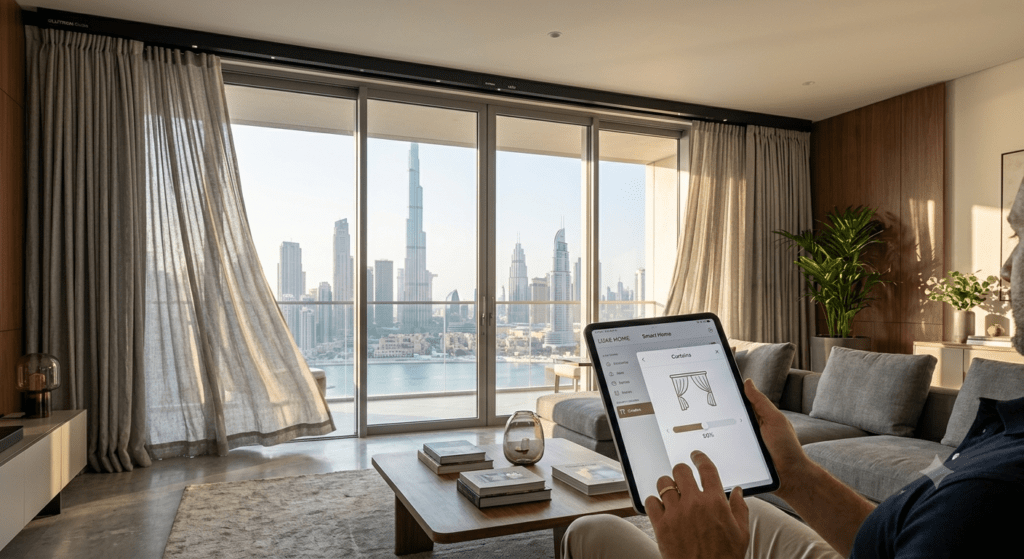
If you have windows that are 3+ meters wide or 3+ meters tall, manually opening and closing curtains becomes a chore. Furthermore, motorized systems integrate with smart home apps, voice assistants, and scheduling. Because of this, you can set curtains to open at sunrise and close before peak heat hours automatically. Additionally, motorized curtains suit expensive fabrics better because they operate gently without hand-pulling strain. In short, they add convenience and extend fabric life.
The Cost Factor
Motorized systems cost 40-60% more than manual curtains. However, they pay back over time through energy savings (automatic closing during peak heat) and reduced manual operation wear. For a typical Dubai villa with 6+ large windows, energy savings alone can recover the cost within 3-4 years. Therefore, if you’re building a new villa or renovating, motorized is a smart investment.
How to Protect Living Room Curtain Fabrics from Harsh Dubai Sunlight
Even the best fabrics need care in Dubai’s sun. Here are practical steps our team uses to ensure longevity:
Choose UV-Protective Fabrics
Many modern fabrics come with UV-blocking treatments. Specifically, ask for fabrics with a UPF (Ultraviolet Protection Factor) rating of 50+. This blocks 98% of UV rays. Because UV rays fade dyes and weaken fibers, this matters. Therefore, don’t buy the cheapest option—mid-range fabrics with UV treatment outlast budget fabrics by years.
Use Thermal Backing
Thermal backing is a white or reflective lining on the back of curtains that reflects heat outward. Moreover, it protects the front fabric from fading. In addition, it improves insulation. As a result, thermal backing is non-negotiable for Dubai living rooms.
Schedule Regular Maintenance
Dubai’s dusty air settles on fabrics, trapping UV rays against the surface. Therefore, vacuum curtains monthly with a soft brush attachment. Furthermore, professional dry-cleaning every 12-18 months keeps them fresh. Finally, rotate curtains every 6 months if possible to ensure even sun exposure.
Custom Sizing and Design Options for Dubai Living Rooms
Off-the-shelf curtains from big retailers rarely fit perfectly. Because Dubai homes have unusual layouts—floor-to-ceiling windows, angled ceilings in villas, curved walls—custom is often the only real option. Specifically, custom velvet drapes in Dubai and tailored solutions mean your curtains fit exactly, operate smoothly, and look intentional. In addition, custom curtains cost only 20-30% more than quality ready-made, making them excellent value.
What You Can Customize
Your fabric choice, lining, opacity level, heading style (pinch pleat, wave fold, pencil pleat), and length. Furthermore, you can add embroidery, monograms, or pattern details. For example, embroidered curtain designs add a personal touch to formal living rooms. Finally, custom options let you create a look that’s completely yours.
Why Custom Works Better in Dubai
Most Dubai apartments and villas don’t match standard window sizes. Moreover, custom fabrication means exact color matching, precise measurements, and professional installation in one service. Because of this, you avoid the hassle of ordering, returning, and installing multiple sets. In our experience at Curtain Crew, custom orders take 2-3 weeks and arrive ready to install.
Budget and Timeline: What to Expect When Buying Curtains in Dubai
Curtain pricing varies wildly depending on fabric, size, and features. Here’s a realistic breakdown based on what we install daily in Dubai:
Budget Option: Basic blackout polyester curtains, ready-made or semi-custom, for a standard living room (2-3 windows). Cost: AED 1,500–3,500. Timeline: 3-5 days.
Mid-Range: Quality fabric (linen blend, high-thread polyester), custom sizing, professional installation, 2-3 windows. Cost: AED 4,000–8,000. Timeline: 2-3 weeks.
Premium: Designer fabric (velvet, high-end linen), motorized tracks, double-layer setup, custom design details, 3-4 windows. Cost: AED 12,000–25,000+. Timeline: 3-4 weeks.
Why Prices Vary
Fabric quality makes the biggest difference. Moreover, window size drives quantity and therefore price. In addition, motorization, custom details, and installation complexity add cost. Finally, imported designer fabrics cost more than local suppliers. Importantly, we don’t recommend buying the cheapest option—cheap fabrics fade, tear, and disappoint within a year in Dubai’s climate.
Common Mistakes to Avoid When Choosing Living Room Curtains
In our 8+ years serving Dubai homeowners, we’ve seen these mistakes repeatedly:
Choosing Style Over Function
Beautiful sheer curtains look great but offer zero heat protection. Therefore, prioritize UV blocking and thermal backing first, then choose a color or pattern you love within that constraint.
Incorrect Measurements
We cannot stress this enough: measure three times, order once. Specifically, curtains that don’t reach the floor or are too short create a sloppy look and don’t block light properly.
Underestimating Dubai’s Dust
Dust accumulates quickly on heavy fabrics. Therefore, choose easy-care fabrics (polyester blends) unless you’re willing to professional-clean annually.
Buying Without Professional Consultation
An expert site visit reveals issues photos and measurements miss—odd angles, HVAC vents, structural limitations. As a result, professional consultation saves money and disappointment.
Frequently Asked Questions About Living Room Curtains in Dubai
What’s the difference between blackout and thermal curtains?
Blackout curtains block light and UV rays through dense weaves or coatings. Thermal curtains add insulating backing to reduce heat transfer. Many curtains are both blackout and thermal. Specifically, look for fabrics with both specifications if you want maximum heat and light blocking in one layer.
Can I install curtains myself or should I hire a professional?
If your windows are small and rod mounting is simple, DIY is possible. However, for floor-to-ceiling windows, motorized systems, or angled ceilings (common in Dubai villas), professional installation ensures they hang straight, operate smoothly, and look polished. Moreover, professionals have proper equipment and insurance. Therefore, we recommend professional installation for most Dubai homes.
How often should I clean curtains in Dubai?
Dust settles on curtains every 2-4 weeks in Dubai’s arid climate. Specifically, vacuum with a brush attachment monthly. Furthermore, professional dry-clean every 12-18 months to remove deep dust and refresh the fabric. This maintenance extends the life by years and keeps them looking fresh.
What’s the best way to reduce heat from south-facing windows in a Dubai villa?
South-facing windows get intense afternoon sun, so dark, heavy blackout curtains with thermal backing are essential. Moreover, motorized systems that close automatically during peak heat (1–5 PM) make the biggest impact. Additionally, combining blackouts with reflective thermal backing can reduce indoor temperatures by 8-12°C on those windows alone.
Ready to Transform Your Living Room with the Perfect Curtains?
Choosing the right curtains for your Dubai living room brings comfort, saves energy, and protects your investment. Moreover, with so many options available, expert guidance makes all the difference. Therefore, the first step is a professional in-home consultation where our team measures, assesses your light and heat exposure, and recommends solutions tailored to your space and budget.
At Curtain Crew DXW, we’ve been helping Dubai homeowners, tenants, and designers find perfect window solutions since 2015. Specifically, our team handles everything from consultation to custom fabrication to professional installation. In addition, we offer motorized options, luxury fabrics, and bespoke designs. Furthermore, we serve Dubai Marina, Downtown Dubai, Business Bay, JBR, Arabian Ranches, and across the UAE.
Get Started Today:
📱 WhatsApp us now: https://wa.me/971553485781
📍 Serving: Curtains Dubai Marina | Curtains Business Bay | Curtains JBR | Curtains Abu Dhabi | Custom Curtains UAE
Click the link to schedule your FREE consultation. We’ll visit your home, take exact measurements, show you fabric samples, and provide a custom quote—all with no obligation. Moreover, our customers enjoy professional installation and 2-year quality guarantees on all custom work. Explore our full collection of ready-made and custom curtains at https://curtaincrewdxw.ae/ and see why hundreds of Dubai families trust Curtain Crew for their window solutions.