

Luxury curtains in Dubai are custom-made window treatments using premium fabrics like velvet, silk-blend, or heavyweight linen, paired with thermal or blackout lining and motorized or designer hardware, typically priced from AED 250 to AED 900+ per metre depending on fabric and finish.
Luxury curtains in Dubai combine heavyweight natural fabrics, precisely made-to-measure tailoring, and hardware built to handle heat, humidity, and heavy air-conditioning use. In our experience fitting homes across Dubai Marina, Business Bay, JBR, and Abu Dhabi, the difference between a “nice curtain” and a genuinely luxury one comes down to fabric weight, lining quality, and how well the whole system is engineered for this climate
If you’ve searched “luxury curtains Dubai” and landed on generic listings with no real pricing or fabric guidance, this guide is meant to fix that. We’ll walk through fabric choices, styles, realistic costs, climate considerations, and the mistakes we see most often when homeowners order curtains for a villa or high-rise apartment.
What Makes Curtains “Luxury” vs. Regular Curtains?
Luxury curtains are defined by fabric weight and composition, tailoring precision, and hardware quality — not just price. A regular curtain is usually a lightweight, pre-made polyester panel bought off the shelf in a standard size.
A luxury curtain, by contrast, is cut to your exact window dimensions, uses natural or high-density fabric blends, and is finished with proper interlining so the drape falls in clean, heavy folds rather than sitting flat against the glass.
In our workshop, we typically judge “luxury” by three things:
Fabric GSM (grams per square metre): anything below 250 GSM tends to look thin once hung; luxury fabrics usually start around 350–500 GSM.
Construction: pinch-pleat or wave headings, proper interlining, and weighted hems.
Hardware: solid brass or powder-coated aluminium tracks, not the plastic rail systems found in budget setups.
This matters even more in Dubai because thin, low-GSM curtains sag and discolour faster under strong UV exposure through double-glazed glass.
What Are the Best Luxury Curtain Fabrics for Dubai Homes?
The best luxury curtain fabrics for Dubai homes are velvet, heavyweight linen-cotton blends, and silk-look polyester dupioni, chosen based on the room’s sun exposure and how often the AC runs. Each fabric behaves differently in heat, humidity, and direct sunlight, so the “best” one depends on the room.
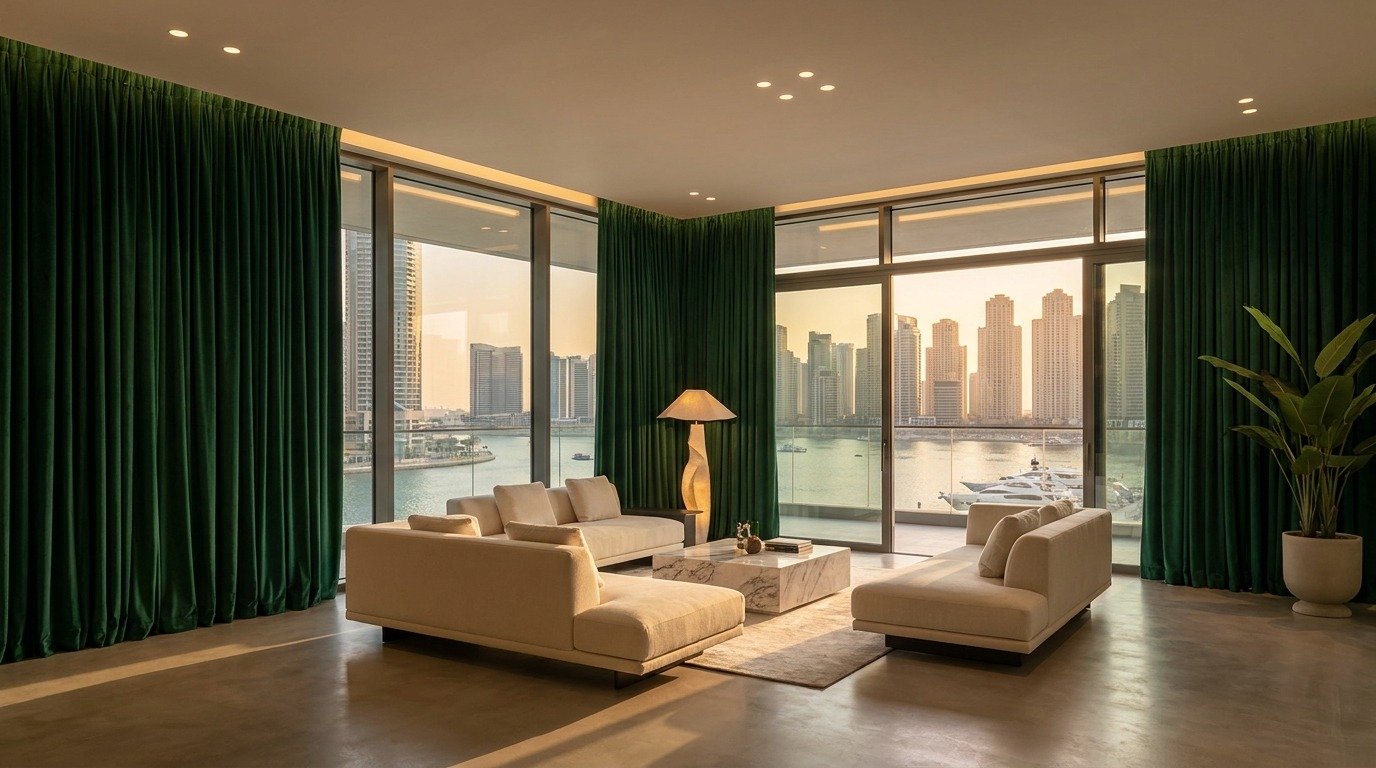
Velvet gives the richest look and blocks light well, but it holds heat, so we usually recommend it for bedrooms and formal living rooms with strong AC rather than sun-facing balconies without curtains behind them.
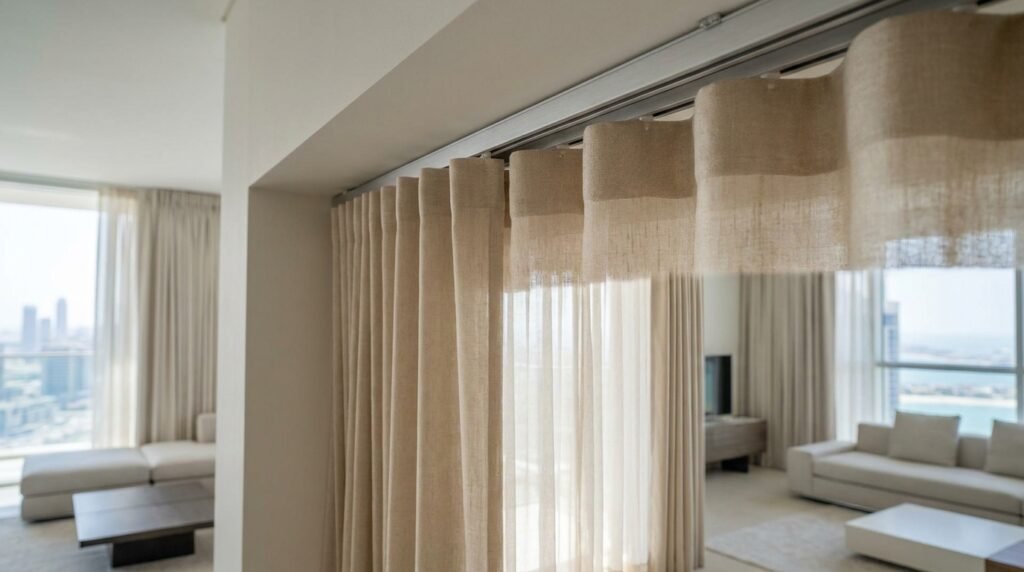
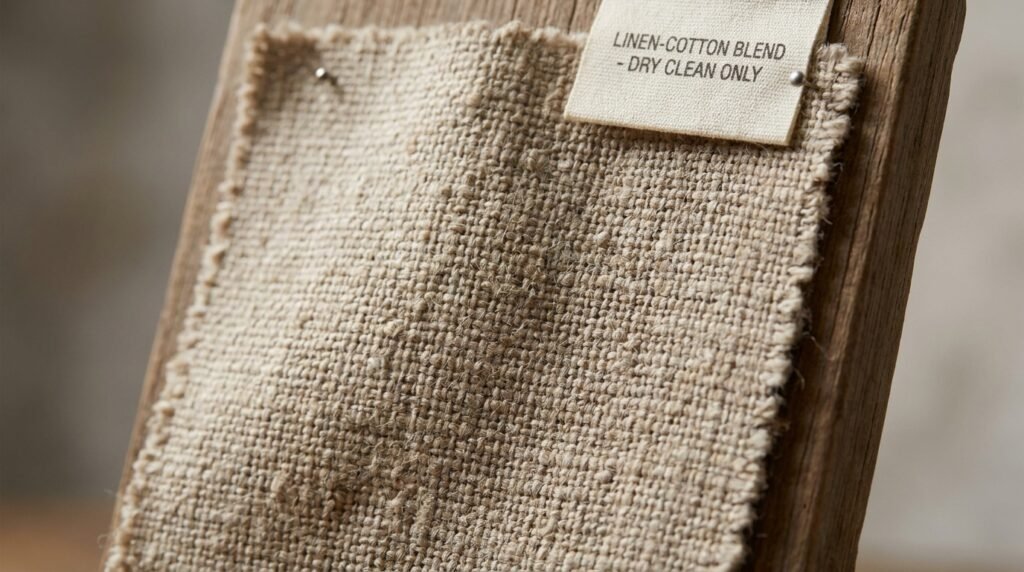
Heavyweight linen-cotton blends breathe better and resist fading, making them a strong choice for JBR and Marina apartments with floor-to-ceiling glass facing the sea.
Silk-look polyester dupioni gives a similar sheen to real silk at a fraction of the price and, unlike genuine silk, doesn’t degrade as quickly under UV exposure — real silk is one fabric we generally steer clients away from on west- or south-facing windows in Dubai, since it can weaken and discolour within one to two summers.
| Fabric | Look & Feel | Best For | Sun Exposure Suitability |
| Velvet | Rich, heavy, plush | Bedrooms, formal lounges | Low–medium sun rooms |
| Linen-cotton blend | Soft, natural texture | Living rooms, villas | Medium–high sun rooms |
| Silk-look polyester | Sheen, elegant drape | Dining rooms, majlis | High sun rooms |
| Real silk | Very fine, delicate | Low-light interior rooms only | Not recommended in direct sun |
Are Velvet Curtains Good for Dubai’s Climate?
Velvet curtains work well in Dubai when paired with a breathable interlining and used in AC-cooled rooms rather than sun-facing balconies without secondary shading. On their own, velvet’s density can trap heat against the glass, which is why we rarely install it as a single layer on west-facing windows.
The fix we use on most villa jobs is a velvet face fabric with a lightweight thermal interlining and a separate sheer layer behind it. This lets the homeowner use the sheer during the day for privacy and light diffusion, then close the velvet drape in the evening for the full luxury look — without the room heating up from trapped solar gain.
Which Curtain Style Suits a Luxury Villa in Dubai?
Luxury villas in Dubai generally suit floor-to-ceiling wave or pinch-pleat curtains in double-layer setups, with a sheer for daytime privacy and a heavier blackout or dim-out layer for evenings. Villas typically have taller ceilings and larger window bays than apartments, so the heading style matters more than in a standard flat.
Wave heading — clean, modern, minimal folds; suits contemporary villa interiors.
Pinch pleat (double or triple) — classic, formal, tailored look; suits majlis rooms and formal dining.
Goblet pleat — most decorative and traditional; suits statement living rooms with high ceilings.
Layered sheer + blackout — near-universal for villa bedrooms and living rooms facing the garden or pool.
For apartments in Business Bay or Dubai Marina, we generally recommend wave heading with motorised tracks, since it suits floor-to-ceiling glass and doesn’t compete visually with the skyline view.
How Much Do Custom Luxury Curtains Cost in Dubai?
Custom luxury curtains in Dubai typically cost between AED 250 and AED 900+ per running metre, depending on fabric, lining, heading style, and whether the track is manual or motorised. A standard living room window (roughly 3–4 metres wide) usually lands between AED 2,500 and AED 8,000 fully installed.
These figures are our typical range based on jobs across Dubai and Abu Dhabi — actual quotes always depend on the specific fabric, width, and finish chosen.
| Component | Typical Price Range (AED) |
| Mid-range linen-cotton blend fabric | 250–450 per metre |
| Premium velvet or silk-look fabric | 450–900+ per metre |
| Blackout/thermal lining | 60–120 per metre |
| Manual track/rod (brass or aluminium) | 150–400 per window |
| Motorised track system | 1,200–3,500+ per window |
| Installation (per standard window) | 150–350 |
A detail most first-time clients don’t budget for: motorisation pricing depends heavily on whether the track needs a hidden power run inside the ceiling or wall, which is far easier to plan during villa construction or renovation than after the ceiling is already closed.
How to Choose Luxury Curtains for a Modern Dubai Apartment?
Choosing luxury curtains for a modern Dubai apartment comes down to matching fabric weight and colour to the amount of glass in the room, then picking a heading style that suits floor-to-ceiling windows without overwhelming the space. Follow these steps:
- Measure the window height and width precisely — floor-to-ceiling glass in most Marina and Business Bay towers needs curtains at least 15–20cm wider than the window on each side for a full, luxury drape.
- Choose fabric based on sun direction — west and south-facing units need heavier or lined fabric; north and east-facing units can use lighter weights.
- Pick a heading style — wave heading generally suits modern, minimal interiors best.
- Decide on layering — sheer plus blackout is the standard combination for bedrooms; a single heavier layer often suits living rooms with good AC coverage.
- Confirm track type — motorised tracks work well for hard-to-reach floor-to-ceiling windows and add a genuinely premium feel day-to-day.
One of the most common mistakes we see is homeowners choosing curtain length based only on the visible window frame, without accounting for the gap above and below — this alone can make an otherwise expensive fabric look under-finished once hung.
For homeowners who want blackout performance specifically rather than a full luxury refresh, our <a href=”https://curtaincrewdxw.ae/2026/07/14/blackout-curtains-dubai-buying-guide/”>blackout curtains Dubai buying guide</a> breaks down fabric density and lining options in more detail.
What We Check On-Site Before Any Luxury Curtain Order
Before quoting any luxury or custom curtain job, our team checks a few things in person rather than relying on photos alone:
Window and wall structure — to confirm the track can be mounted flush, recessed, or ceiling-fixed depending on the fabric weight chosen.
Sun direction and AC vent placement — this affects both fabric choice and how the curtain will hang over time.
Existing gypsum or false ceiling — relevant for any motorised or hidden-track installation.
Floor level and skirting — to get an exact break length, whether the client wants the curtain just to kiss the floor or puddle slightly.
We also offer a standard workmanship warranty on stitching and hardware installation, separate from the fabric manufacturer’s own warranty, so clients know exactly what’s covered if something needs adjustment after installation.
Common Mistakes to Avoid When Buying Luxury Curtains in Dubai
Ordering by width alone — height and gap allowance matter just as much for the drape to look full.
Ignoring sun direction — the same fabric can perform very differently on a north-facing window versus a west-facing one.
Skipping interlining to save cost — this is usually the first place quality is lost, since it affects both drape and heat insulation.
Choosing motorisation after the ceiling is finished — always plan wiring early if motorised tracks are wanted.
Assuming all “velvet” is equal — GSM and weave density vary widely between suppliers and change how the fabric drapes and ages.
What are the best luxury curtain fabrics for Dubai homes?
Velvet, heavyweight linen-cotton blends, and silk-look polyester dupioni are generally the best choices for Dubai homes. The right one depends on how much direct sun the room gets, since fabric behaves differently under strong UV exposure and heavy AC use.
How much do custom luxury curtains cost in Dubai?
Custom luxury curtains in Dubai typically range from AED 250 to AED 900+ per metre depending on fabric and lining, with a standard window fully installed usually costing AED 2,500 to AED 8,000. Motorised tracks add further cost depending on wiring complexity.
Are velvet curtains good for Dubai’s climate?
Yes, but they work best in AC-cooled rooms paired with a thermal interlining, rather than as a single layer on strong sun-facing windows. Pairing velvet with a sheer daytime layer is the most common solution we use.
Which curtain style suits a luxury villa in Dubai?
Floor-to-ceiling wave or pinch-pleat curtains in a double-layer sheer-plus-blackout setup generally suit luxury villas best, especially in bedrooms and living rooms facing the garden or pool.
What makes curtains “luxury” vs. regular curtains?
Luxury curtains use heavier, higher-GSM fabric, proper interlining, and premium hardware like brass or motorised tracks. They are cut to the exact window rather than sold as pre-made standard sizes.
Ready to upgrade your home with made-to-measure luxury curtains? Message our team on WhatsApp for a free on-site measurement and fabric consultation anywhere in Dubai or Abu Dhabi.